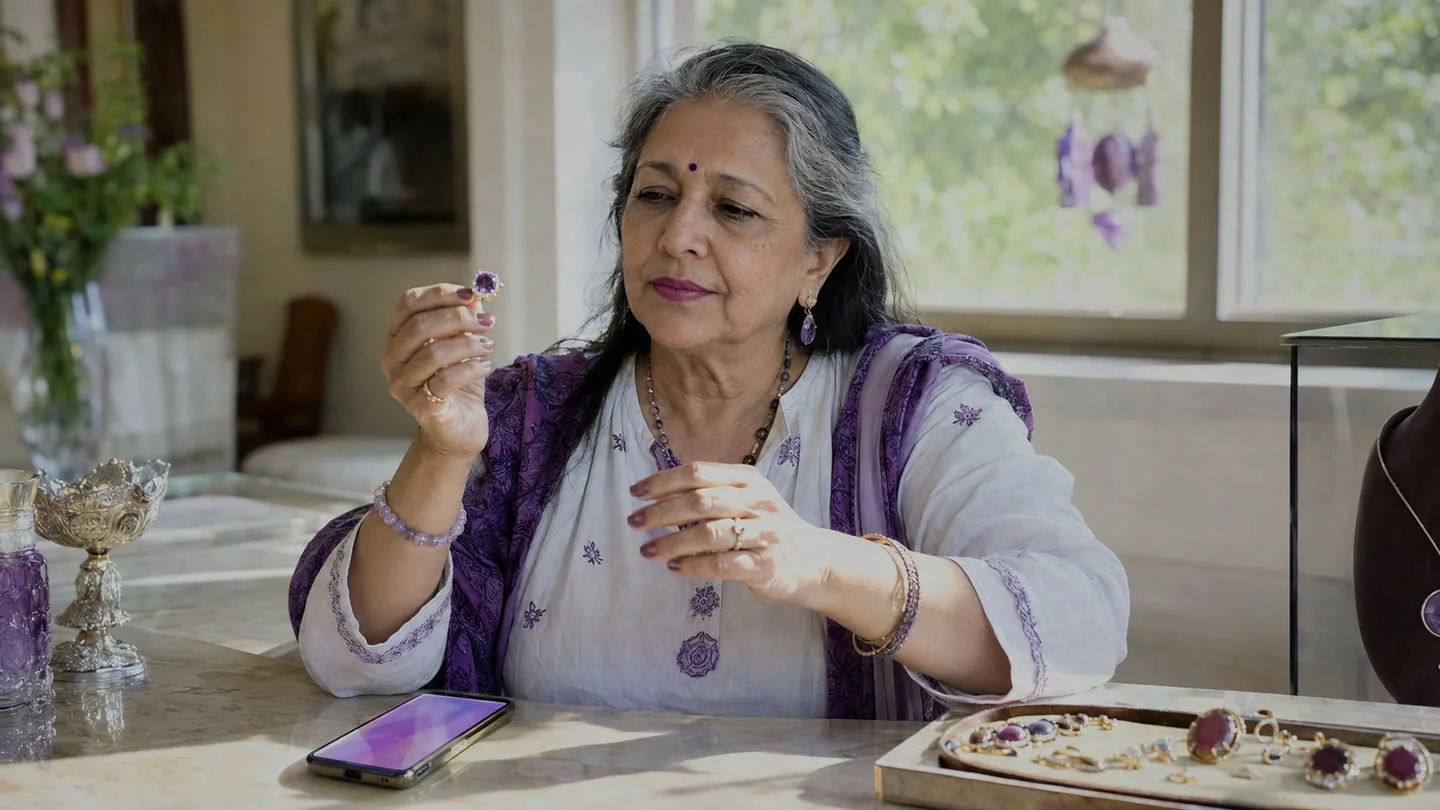
A gemstone's cut transforms rough crystal into wearable art. Unlike shape (oval, round, square), cut refers to the faceting style and proportions that determine how light interacts with the stone. The right cut maximizes a gem's natural beauty while preserving sufficient weight for astrological purposes. Understanding cuts helps you evaluate gemstones like a professional and choose stones that truly shine.
Cut quality affects three optical properties: brilliance (white light return), fire (spectral color dispersion), and scintillation (sparkle when moving). For colored gemstones used in Jyotish, color saturation and even distribution are often prioritized over maximum brilliance.
Brilliant Cut
Facet Count: 57-58 facets (standard round brilliant)
Light Performance: Maximum brilliance and fire
Best Suited For: Diamond, White Sapphire, Zircon, colorless gems
How It Works
The brilliant cut uses triangular and kite-shaped facets arranged in a specific pattern to reflect maximum light back to the viewer's eye. Light enters through the crown (top), bounces between pavilion (bottom) facets, and exits through the crown, creating the famous "sparkle."
Anatomy of a Brilliant Cut
- Table: Large flat top facet (53-57% of diameter ideal)
- Crown: Upper portion with star facets and bezel facets
- Girdle: Thin band where crown meets pavilion
- Pavilion: Lower portion with main and lower girdle facets
- Culet: Tiny flat facet at bottom point (often none in modern cuts)
Astrological Considerations
Brilliant cuts are ideal for Venus stones (Diamond) where maximum sparkle represents Venus's qualities of beauty and attraction. However, for colored stones like Ruby or Blue Sapphire, brilliant cutting may sacrifice color saturation for brilliance - not always desirable for astrological use.
Quality Indicators
- Excellent symmetry between opposing facets
- Proper proportions (not too deep or shallow)
- Even pattern of light and dark areas (not too dark center)
- Good polish without scratches or wheel marks
Step Cut
Facet Count: 50-58 facets (varies by design)
Light Performance: Hall of mirrors effect, flashes of light
Best Suited For: Emerald, Aquamarine, colored stones with good clarity
How It Works
Step cuts feature rectangular facets arranged in parallel rows, like steps on a staircase. Instead of brilliant sparkle, step cuts create broad flashes of light and a sophisticated, understated elegance. The open table reveals the stone's interior, requiring excellent clarity.
Types of Step Cuts
- Emerald Cut: Rectangular with cropped corners, classic choice for emeralds
- Asscher Cut: Square step cut with dramatic X pattern
- Baguette: Elongated rectangle, often used as side stones
- Carré Cut: Square with sharp corners
Astrological Considerations
Step cuts excel at displaying a stone's natural color without the "whitening" effect of brilliant cuts. This makes them ideal for Mercury stones (Emerald) where pure, vivid green color is paramount. The clean geometric lines also resonate with Mercury's logical, organized nature.
Quality Indicators
- Parallel facet edges with no waviness
- Excellent clarity (inclusions are very visible)
- Even color distribution across the stone
- Well-proportioned length-to-width ratio
Mixed Cut
Facet Count: Varies (typically 60-80)
Light Performance: Balance of brilliance and color
Best Suited For: Sapphires, Rubies, Tourmaline, most colored gems
How It Works
Mixed cuts combine brilliant-cut crowns with step-cut pavilions (or vice versa). This hybrid approach offers the sparkle of brilliant cuts while preserving more of the rough stone's weight and enhancing color saturation.
Common Mixed Cut Variations
- Ceylon Cut: Traditional Sri Lankan style with high crown and deep pavilion for maximum weight retention
- Modified Brilliant: Brilliant pattern with adjusted facet shapes for colored gems
- Checkerboard: Square facets creating checkerboard pattern on crown
- Portuguese Cut: Multiple tiers of facets for intense brilliance
Astrological Considerations
Mixed cuts are the most popular choice for astrological gemstones because they balance multiple factors: adequate weight retention, good color display, and pleasing brilliance. Most commercially available Rubies, Yellow Sapphires, and Blue Sapphires feature mixed cuts.
The Ceylon Cut Problem
Many imported stones use the Ceylon cut, which prioritizes weight over beauty. These stones may be poorly proportioned with deep pavilions and small tables. While they retain maximum carat weight, light performance suffers. For astrological use, a well-cut 3-carat stone often outperforms a poorly-cut 4-carat stone of equal quality.
Cabochon Cut
Facet Count: None (smooth dome)
Light Performance: Soft glow, displays optical phenomena
Best Suited For: Cat's Eye, Star Sapphire, Moonstone, Coral, Pearl
How It Works
The cabochon is the oldest cutting style, predating faceting by thousands of years. A flat back meets a smooth, curved dome top. Without facets, cabochons rely on the stone's inherent properties - color, transparency, and special optical effects - for their beauty.
Types of Cabochons
- High Dome: Dramatically curved top, best for phenomenal stones
- Low Dome: Gentle curve, good for transparent materials
- Double Cabochon: Curved on both top and bottom
- Buff Top: Cabochon crown with faceted pavilion
Required for Phenomenal Gems
Certain optical effects only appear in cabochon-cut stones:
- Chatoyancy (Cat's Eye): Single band of light from needle-like inclusions
- Asterism (Star Effect): Four or six-rayed star from rutile silk
- Adularescence: Floating glow in moonstone
- Play of Color: Color flashes in opal
Astrological Considerations
Cabochons are mandatory for Ketu's gem (Cat's Eye Chrysoberyl) and traditional for Coral and Pearl. The smooth surface maximizes skin contact, which some believe enhances energy transfer. Star Rubies and Star Sapphires combine planetary gem benefits with phenomenal effects.
Quality Indicators
- Symmetrical dome with centered high point
- Sharp, well-centered phenomenon (eye or star)
- Smooth surface without pits or scratches
- Good translucency or body color
Rose Cut
Facet Count: 3-24 facets (varies)
Light Performance: Subtle shimmer, antique appearance
Best Suited For: Flat rough, antique jewelry, Diamond, dark stones
How It Works
Rose cuts feature a flat back and domed top covered with triangular facets meeting at a central point. Popular from the 16th-19th centuries, this cut predates the modern brilliant and creates a soft, romantic sparkle reminiscent of a rose bud.
Historical Significance
Before electric lighting and precise cutting technology, the rose cut was the premium choice. Its broader facets gathered available candlelight effectively. Many antique Indian gems, including historical Royal jewels, feature rose cuts.
Variations
- Single Rose: 3-6 facets, simplest form
- Dutch Rose: 24 facets, most common
- Double Dutch Rose: Dome on both sides, 48 facets
- Antwerp Rose: Variation with different facet arrangement
Astrological Considerations
Rose cuts are rarely used for primary Jyotish gems today but appear in antique pieces. Some practitioners value their historical authenticity and believe older cutting styles carried traditional knowledge. Rose-cut diamonds can be an affordable Venus stone alternative.
Fancy Cuts
Facet Count: Varies widely
Light Performance: Depends on specific design
Best Suited For: Unique specimens, collector pieces
Examples of Fancy Cuts
- Briolette: Tear-drop fully covered in triangular facets
- Flower Cut: Facets arranged in petal patterns
- Concave Cut: Inward-curving facets for dramatic brilliance
- Fantasy Cut: Artistic, one-of-a-kind designs
- Laser Cut: Precision patterns impossible by hand
Astrological Considerations
Fancy cuts are generally not recommended for Jyotish purposes. Their unconventional patterns lack traditional precedent, and some have reduced skin contact (briolettes are meant for pendants, not rings). However, if a fancy-cut stone meets all other quality criteria and is worn correctly, there's no definitive prohibition against it.
Understanding Proportions
A gemstone's proportions dramatically affect its appearance. Even a beautifully colored stone can appear dull if poorly proportioned.
Common Proportion Problems
- Too Deep: Light leaks out bottom, stone appears dark in center
- Too Shallow: Light passes straight through, stone looks watery or "windowed"
- Bulge (Native Cut): Extra weight in pavilion without optical benefit
- Off-Center Culet: Asymmetric light pattern
Ideal Characteristics
- Light returns evenly across the face
- No dark "extinction" zones when moving the stone
- No "window" (seeing through to mounting underneath)
- Balanced appearance from all viewing angles
When to Consider Recutting
Some poorly-cut gems can be recut to improve appearance, but this involves trade-offs:
Recutting Benefits
- Removes surface scratches and chips
- Improves proportions and brilliance
- Can eliminate some surface-reaching inclusions
- Modernizes antique cuts
Recutting Risks
- Weight loss (5-50% depending on extent)
- Costly for high-end stones
- May reveal previously hidden inclusions
- Not reversible - original form is lost
Astrological Implications
For stones used in Jyotish, weight matters. A 5-carat Yellow Sapphire recut to 3.5 carats may look better but might fall below recommended weight for your chart. Always consult your astrologer before recutting a planetary gemstone.
Cut Recommendations for Navaratna
- Ruby (Sun): Mixed cut or brilliant - prioritize color saturation
- Pearl (Moon): Natural spherical or baroque - no cutting needed
- Red Coral (Mars): Cabochon or capsule - traditional forms
- Emerald (Mercury): Step cut (emerald cut) - shows clarity and color
- Yellow Sapphire (Jupiter): Mixed cut - balance of brilliance and color
- Diamond (Venus): Brilliant cut - maximum sparkle and fire
- Blue Sapphire (Saturn): Mixed or cushion - preserves deep color
- Hessonite (Rahu): Mixed cut or cabochon - traditional preference
- Cat's Eye (Ketu): Cabochon only - required for chatoyancy
Conclusion
Understanding gemstone cuts empowers you to evaluate stones beyond simple carat weight. A well-cut stone of modest size often outperforms a larger, poorly-cut specimen in both beauty and (arguably) astrological effectiveness.
For astrological purposes, prioritize: (1) natural, untreated material, (2) good clarity and color, (3) adequate weight for your chart, and (4) appropriate cut quality. An expensive "ideal cut" isn't necessary, but avoid severely windowed or overly deep stones.
Learn how origin affects quality in our next lesson: Gemstone Origins & Quality.